

An SEO consultant is a specialist who analyzes how a website performs in organic search, identifies the issues and opportunities affecting its visibility, and develops a prioritized strategy for improving search performance and business results.
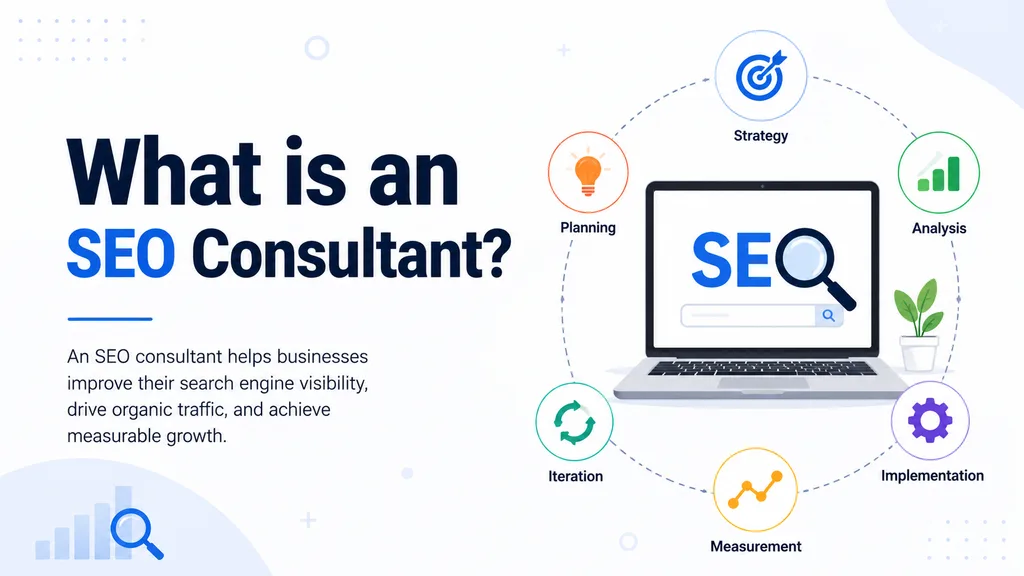
That can involve technical SEO, keyword research, content strategy, site architecture, on-page optimization, internal linking, authority analysis, analytics and increasingly the way content appears across features such as Google AI Overviews and AI Mode.
But the most valuable part of SEO consulting is not completing a long checklist.
It is determining what is preventing a particular website from performing better, which opportunities matter most, and what the business should do next.
This guide explains what an SEO consultant does, what services and deliverables you should expect, when hiring one makes sense and how to evaluate whether a consultant is genuinely qualified.
What Does an SEO Consultant Do?
An SEO consultant typically diagnoses organic-search problems, identifies growth opportunities and determines which actions should receive priority.
The exact work varies because websites fail to perform for different reasons.
A technically strong website may have poor content.
A content-rich website may have weak internal architecture.
Another business may already rank for hundreds of keywords but attract the wrong search intent.
That is why competent consulting starts with diagnosis rather than a predetermined package.
1. Understand the business and search opportunity
Before making SEO recommendations, a consultant should understand:
- what the company sells;
- its most valuable products or services;
- target customers;
- geographic markets;
- competitors;
- sales cycle;
- conversion points;
- existing marketing resources;
- technical limitations.
Without this information, SEO can easily become a project focused on increasing arbitrary traffic rather than producing useful business outcomes.
2. Audit current organic-search performance
A consultant may examine information from sources such as:
- Google Search Console;
- Google Analytics;
- the website’s CMS;
- crawling tools;
- rank-tracking platforms;
- backlink databases;
- server logs where appropriate;
- competitor research.
The objective is not to collect the largest possible number of errors.
It is to determine where meaningful performance is being lost.
For example, a crawl may identify hundreds of technical warnings. Only a small number may materially affect crawling, indexing, page consolidation or user experience.
Prioritizing those issues is part of the consultant’s job.
3. Diagnose technical SEO problems
Technical SEO determines whether search engines can efficiently discover, crawl, render, understand and index important content.
A consultant may investigate:
- crawlability;
- indexation;
- robots.txt;
- XML sitemaps;
- canonical URLs;
- redirects;
- duplicate content;
- JavaScript rendering;
- site architecture;
- internal linking;
- structured data;
- mobile usability;
- Core Web Vitals;
- page performance;
- HTTP errors;
- site migrations.
Not every technical issue needs immediate attention.
The consultant should distinguish between cosmetic tool warnings and problems with genuine search impact.
4. Research keywords and search intent
Keyword research is not simply finding phrases with large search volumes.
A consultant should determine:
- what potential customers search for;
- what they mean when using those searches;
- whether Google interprets the query as informational, commercial, transactional, local or another intent;
- which existing page should target the topic;
- whether a new page is genuinely justified;
- how competitive the opportunity is;
- how closely the query relates to the business.
This prevents a common SEO mistake: attracting traffic that was never likely to become useful to the company.
5. Build a content strategy
An SEO consultant may identify:
- missing service pages;
- weak landing pages;
- informational topics;
- content clusters;
- overlapping pages;
- outdated articles;
- content that should be consolidated;
- opportunities for original research or examples.
A good content strategy should build subject expertise and help the intended audience—not generate hundreds of pages simply because keyword tools found hundreds of phrases.
Google specifically warns that producing large amounts of unoriginal content primarily to manipulate rankings can constitute scaled content abuse, regardless of whether the content was produced manually or with AI.
6. Improve on-page SEO and internal linking
SEO consulting may involve improving:
- page titles;
- main headings;
- page structure;
- topical coverage;
- entity clarity;
- internal links;
- anchor text;
- images;
- descriptive alt text;
- conversion paths.
Internal linking deserves particular attention because it helps users discover related information while helping search engines understand relationships between pages.
The objective is not to repeat exact-match keywords everywhere.
Links should make sense within the site’s information architecture.
7. Evaluate authority and backlinks
Backlinks can still be useful signals of discovery and authority, but professional SEO should not be reduced to buying links.
A consultant may evaluate:
- existing backlink quality;
- lost links;
- linkable assets;
- digital PR opportunities;
- relevant industry citations;
- competitor link profiles;
- suspicious link-building practices.
Any recommendation should remain consistent with Google’s spam policies rather than attempting to manufacture ranking signals through manipulative link schemes.
8. Prioritize recommendations
This is one of the most important and underexplained parts of SEO consulting.
A 100-page audit containing 300 recommendations is not automatically valuable.
Businesses have limited:
- development time;
- content resources;
- budget;
- stakeholder attention.
A useful consultant should therefore prioritize actions according to factors such as:
| Factor | Question |
| Business impact | Could this materially affect leads, sales or valuable visibility? |
| Search impact | Is the issue actually restricting organic performance? |
| Effort | How difficult is implementation? |
| Dependency | Does another task need to happen first? |
| Risk | Could the change damage current performance? |
| Confidence | How strong is the evidence behind the recommendation? |
The output should become a roadmap rather than an unfiltered list of SEO problems.
9. Support implementation
Not every SEO consultant implements every recommendation personally.
Depending on the engagement, the consultant may work with:
- developers;
- copywriters;
- designers;
- marketing managers;
- PR teams;
- product teams;
- leadership.
This is an important distinction when choosing between a consultant and an agency.
A business with capable internal execution may primarily need senior SEO direction.
A business without writers, developers or marketing resources may need a provider with greater delivery capacity.
10. Measure results and adjust strategy
SEO should be measured after implementation.
Useful metrics can include:
- organic clicks;
- qualified impressions;
- visibility for commercially important queries;
- landing-page performance;
- conversions;
- enquiries;
- sales;
- assisted conversions;
- indexed-page quality;
- crawl/indexing improvements.
Rankings can help diagnose performance, but a consultant should not treat rankings as the only objective.
The ultimate question is:
Did improved search visibility create meaningful value for the business?
What Services Does an SEO Consultant Provide?
The exact scope differs, but common SEO consulting services include:
| Area | Typical work |
| SEO audit | Identify technical, content and strategic problems |
| Technical SEO | Crawling, indexing, rendering, architecture and performance |
| Keyword research | Discover relevant demand and search intent |
| Content strategy | Determine what should be created, improved or consolidated |
| On-page SEO | Improve page structure, relevance and usability |
| Internal linking | Strengthen discovery and topical relationships |
| Competitor research | Identify competing pages, entities and opportunities |
| Authority analysis | Evaluate backlinks and reputation signals |
| Site migrations | Protect organic visibility during major website changes |
| SEO reporting | Measure organic and business outcomes |
| SEO training | Improve internal team capabilities |
| AI Search strategy | Adapt conventional SEO principles to AI-powered Search experiences |
The correct mix depends on the site’s actual constraints.
What Should an SEO Consultant Actually Deliver?
Businesses should expect more than verbal recommendations.
Depending on scope, useful deliverables can include:
- technical SEO audit;
- prioritized roadmap;
- keyword research;
- search-intent mapping;
- content plan;
- page recommendations;
- content briefs;
- internal-linking plan;
- implementation tickets;
- migration plan;
- measurement framework;
- regular performance reports.
The important distinction is that deliverables should explain what needs to change, why it matters, how important it is and how success will be measured.
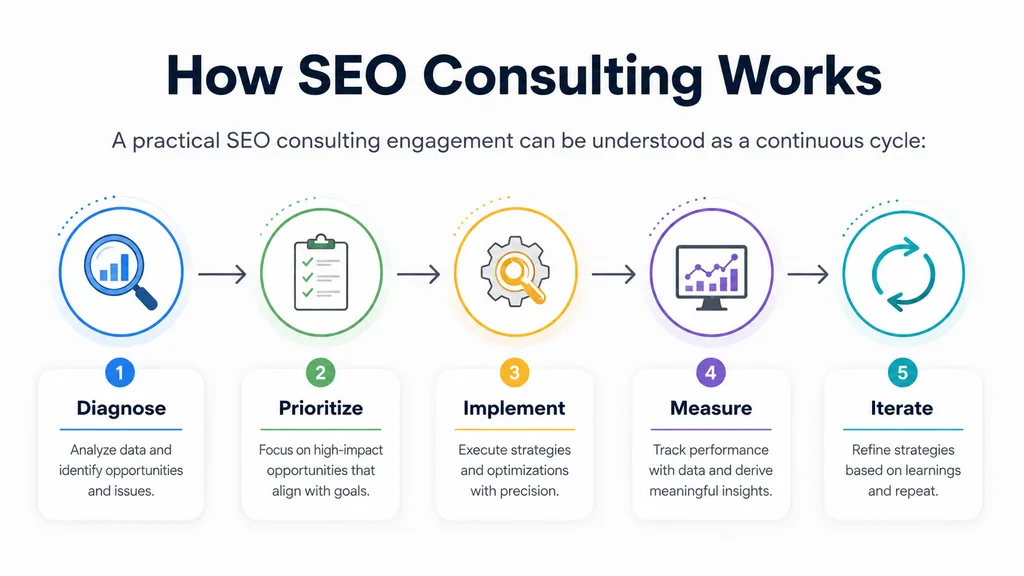
How SEO Consulting Works
A practical SEO consulting engagement can be understood as a continuous cycle:
Diagnose → Prioritize → Implement → Measure → Iterate
Diagnose: Determine what is currently limiting performance.
Prioritize: Select the opportunities most likely to produce meaningful improvements.
Implement: Make the changes or coordinate the people responsible for them.
Measure: Determine whether search and business performance changed.
Iterate: Use what was learned to decide the next priority.
That model prevents SEO from becoming a collection of disconnected activities.
When Should You Hire an SEO Consultant?
Consider hiring an SEO consultant when your business has an organic-search problem or opportunity that requires expertise you do not currently have internally.
Common situations include:
Organic traffic or leads have declined
A consultant can investigate whether the problem relates to:
- rankings;
- technical changes;
- indexing;
- search demand;
- competitors;
- content quality;
- website changes;
- search-result features.
Your website gets traffic but few enquiries
The problem may be query intent, page targeting or conversion alignment rather than visibility alone.
You are redesigning or migrating your website
This is one of the best times to involve an SEO early.
Google also recommends considering professional SEO assistance during a redesign or new-site launch so search considerations can be incorporated before problems are built into the site.
You are planning substantial content growth
A consultant can help determine:
- what topics deserve pages;
- which existing pages should be improved;
- how the site should be structured;
- where cannibalization could occur;
- how pages should link together.
Your internal marketing team needs specialist direction
You may already have writers, developers and marketers but lack senior SEO expertise.
In this situation, a consultant can provide diagnosis and direction while your existing team handles implementation.
SEO Consultant vs SEO Agency vs In-House SEO
There is no universally superior option.
The best model depends on the problem you need to solve.
| Factor | SEO Consultant | SEO Agency | In-House SEO |
| Senior specialist access | Usually direct | Varies | Direct |
| Execution capacity | Limited to consultant/resources | Usually highest | Depends on team |
| Business familiarity | Develops over engagement | Develops over engagement | Usually highest |
| Flexibility | Often high | Depends on contract/process | High internally |
| Breadth of specialists | Usually lower | Usually higher | Depends on team size |
| Best fit | Strategy, diagnosis, specialist guidance | Multi-discipline execution at scale | Continuous internal ownership |
A consultant can be particularly effective when a business already has people who can execute recommendations but needs stronger SEO diagnosis and prioritization.
An agency may make more sense when significant content, development, outreach and project-management capacity is required simultaneously.
What Results Can an SEO Consultant Realistically Achieve?
A competent consultant may help improve:
- search visibility;
- crawlability;
- indexation;
- organic traffic;
- qualified landing-page traffic;
- leads;
- sales;
- content performance;
- website architecture;
- internal SEO capability.
But results depend on many factors outside the consultant’s direct control, including:
- competition;
- website authority;
- implementation speed;
- technical limitations;
- business resources;
- search demand;
- Google systems;
- competitors’ actions.
SEO recommendations should therefore be accompanied by evidence and realistic expectations—not guaranteed rankings.
How Long Does SEO Take?
There is no universal SEO timeline.
Some technical changes may produce observable effects relatively quickly after Google recrawls and reprocesses pages.
More competitive growth involving new content, authority development or substantial site improvements can take considerably longer.
Even Google notes that after significant improvements, effects may occur within days in some cases but can also take several months as its systems reassess a site.
A consultant should therefore provide a timeframe based on:
- the current problem;
- implementation requirements;
- competitive environment;
- expected recrawling/reindexing;
- available resources.
Can an SEO Consultant Guarantee Rankings?
No credible SEO consultant can guarantee a #1 ranking on Google.
Google explicitly warns businesses against SEOs claiming guaranteed rankings, a special relationship with Google or priority submission capabilities.
This does not mean an SEO consultant cannot forecast opportunities.
A professional can estimate:
- likely opportunity;
- relative difficulty;
- necessary work;
- expected direction;
- reasonable performance scenarios.
But a forecast is different from a guarantee.
How Has AI Search Changed the SEO Consultant’s Role?
AI Overviews and AI Mode have expanded the ways people discover information, but they have not replaced the foundations of SEO.
According to Google’s current documentation, there are no special technical requirements or additional optimization methods required to appear in AI Overviews or AI Mode beyond normal Search eligibility and SEO best practices.
For an SEO consultant, that means modern search strategy should increasingly consider:
- clear entity identification;
- direct answers to important questions;
- factual accuracy;
- original information;
- useful supporting evidence;
- well-structured pages;
- crawlability;
- internal relationships between topics;
- strong page experience;
- brand and author clarity.
However, businesses should be cautious when someone presents speculative “GEO” tactics as confirmed Google ranking requirements.
Google itself advises businesses to check whether consultants offering AI-search optimization advice are following Google’s official guidance.
How to Choose a Good SEO Consultant
Look beyond promises and keyword rankings.
A credible consultant should be able to explain:
How they diagnose problems
They should not already know the solution before understanding your website.
How they prioritize SEO
Ask what they would do first and why.
How they measure success
The answer should connect organic performance to your business objectives.
How they communicate recommendations
You should understand:
- what will change;
- why;
- who is responsible;
- what result is expected.
Whether their recommendations follow current Search guidance
Google recommends asking potential SEO providers whether they follow Search Essentials and whether their recommendations can be supported by official documentation where relevant.
Whether they can demonstrate relevant work
Case studies, examples, references and real deliverables are more useful than vague claims about “secret ranking methods.”
Red Flags to Avoid
Be cautious if an SEO consultant:
- guarantees #1 rankings;
- refuses to explain their methods;
- claims a special relationship with Google;
- promises instant results for competitive searches;
- prioritizes hundreds of pages without explaining their value;
- relies primarily on buying links;
- treats third-party SEO-tool scores as Google’s internal ranking scores;
- recommends tactics that conflict with Search Essentials;
- sells proprietary “AI ranking tricks” as confirmed Google requirements;
- reports only rankings while ignoring business outcomes.
Google also notes that third-party SEO tools do not have access to Google’s internal ranking data and are not “approved” by Google Search.
Tools are useful.
They are not substitutes for professional judgment.
Questions to Ask Before Hiring an SEO Consultant
Ask prospective consultants:
- How would you learn about my business before building an SEO strategy?
- What information would you need from Google Search Console and analytics?
- How do you decide which SEO problems should receive priority?
- Which parts of your recommendations will you implement yourself?
- Which tasks will require my developers or content team?
- How will success be measured?
- What should I realistically expect during the first few months?
- Can you show examples of relevant previous work?
- How do you respond when a recommended SEO change does not produce the expected result?
- How do you keep your recommendations aligned with current Google Search guidance?
- How are you approaching AI Overviews and AI Mode?
- Are there any SEO tactics you deliberately avoid?
The quality of the consultant’s reasoning is often more revealing than a polished sales presentation.
Final Takeaway
An SEO consultant is not simply someone who “gets websites to rank.”
The role is better understood as a combination of diagnosis, strategy, prioritization, implementation guidance and performance analysis.
The right consultant identifies where organic-search opportunity exists, determines what is preventing the website from capturing it and develops a realistic roadmap for improvement.
For businesses evaluating SEO support, the most important questions are therefore not:
“How many keywords can you rank?”
or:
“Can you get me to number one?”
Better questions are:
What is limiting our organic growth, what should we do first, why does it matter, and how will we know whether it worked?
If you want to discuss your website and determine whether SEO consulting is appropriate for your situation: